문제 풀이/BOJ 문제 풀이
[BOJ알고리즘, C++]#1753_최단 경로, 다익스트라
Hardii2
2023. 12. 15. 23:15
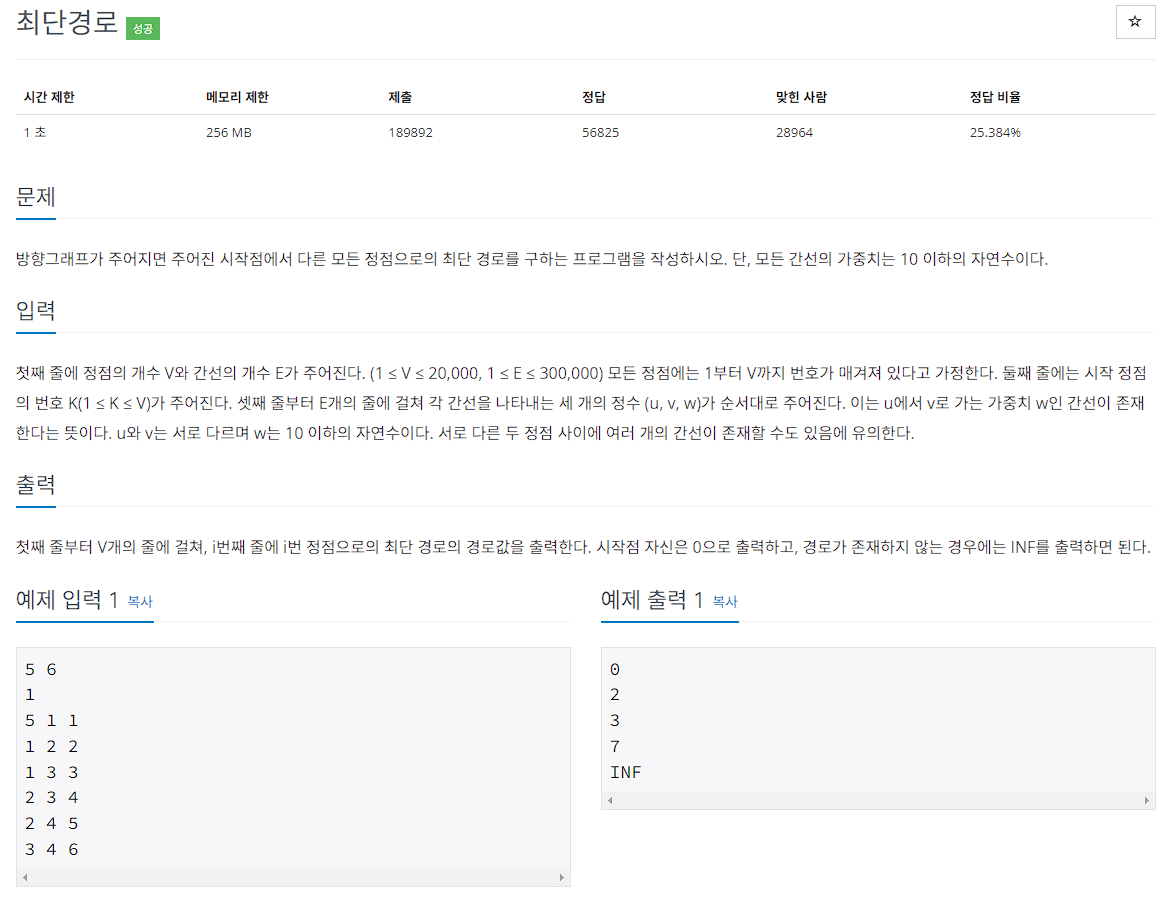
#1. 문제
#2. 풀이
1. 최단 경로 알고리즘
[알고리즘]#2_길 찾기 알고리즘
[알고리즘]#2_길 찾기 알고리즘 길 찾기 알고리즘에 대해 알아보겠습니다. Overview 개념 BFS 다익스트라 벨만포드 플로이드 워셜 A* 알고리즘 내비게이션 메시 #0. 개념 1. 길 찾기 알고리즘? 길 찾기
webddevys.tistory.com
Details
최단 경로 알고리즘은 그래프 내 출발점에서 도착점 사이의 최단 경로를 탐색하는 알고리즘입니다. 다양한 종류의 길 찾기 알고리즘이 있으며, 그 선택은 그래프의 크기, 가중치의 종류, 실행 시간 제약 등 다양한 제약 사항들을 고려합니다. 대표적인 최단 경로 알고리즘은 다익스트라 알고리즘, 벨만-포드 알고리즘, 그리고 플로이드 워셜 알고리즘 등이 있습니다.
2. 다익스트라 알고리즘 활용!
1. 입력받은 시작점을 인덱스로 가중치 + 도착점을 pair 형식으로 저장합니다.
2. 다익스트라 알고리즘은 방문여부 체크와 우선순위 큐를 활용합니다.
#3. 코드
/*
    [문제] : 다익스트라 활용 그래프의 단일 출발 최단 경로 값

    [풀이] : 다익스트라 알고리즘

    1. 2차원 벡터를 통해 그래프 초기화, vector<vector<int>> 형식은 메모리 낭비가 크기 때문에, vector<vector<pair<int,int>>> 형식으로 그래프 선언
    2. 우선순위 큐 활용한 다익스트라 진행

*/

#include <iostream>
#include <queue>
#include <climits>
using namespace std;

int V,E,K;

void Dijkstra(vector<vector<pair<int,int>>>& graph, int start)
{
    //방문 여부
    vector<bool> visited(V+1, false);
    //최단 경로
    vector<int> dist(V+1, INT_MAX);
    //우선 순위 큐 : pair< 최단 경로 값, 정점 >
    priority_queue<pair<int,int>, vector<pair<int,int>>, greater<pair<int,int>>> pq;

    //시작 정점 초기화
    dist[start] = 0;
    pq.push({0, start});

    //우선 순위 큐 순회
    while(!pq.empty())
    {
        // #1. 최단 경로 값이 가장 작은 정점 추출
        int cur_weight = pq.top().first;
        int cur_vertex = pq.top().second;

        pq.pop();

        if(visited[cur_vertex])
            continue;

        visited[cur_vertex] = true;

        // #2. 최소 최단 경로 값을 갖는 정점의 인접 노드들 방문
        for(auto next : graph[cur_vertex])
        {
            int next_vertex = next.first;
            int next_weight = next.second;

            // #3. 인접 노드들의 최단 경로 값 갱신 여부 확인
            int new_dist = dist[cur_vertex] + next_weight;
            if(new_dist < dist[next_vertex])
            {
                dist[next_vertex] = new_dist;
                pq.push({new_dist, next_vertex});
            }
        }
    }

    for(int i=1; i<=V; i++)
    {
        if(dist[i] == INT_MAX)
            cout << "INF" << '\n';
        else
            cout << dist[i] << '\n';
    }

}

int main()
{
    ios_base::sync_with_stdio(false);cin.tie(0);cout.tie(0);
    // V = 정점의 개수, E = 간선의 개수, K = 시작 정점
    cin >> V >> E;
    cin >> K;
    // 그래프 초기화
    vector<vector<pair<int,int>>> graph(V+1);

    for(int i=0; i<E; i++)
    {
        int u,v,w;
        cin >> u >> v >> w;

        graph[u].push_back({v,w});
    }

    Dijkstra(graph, K);

    return 0;
}